



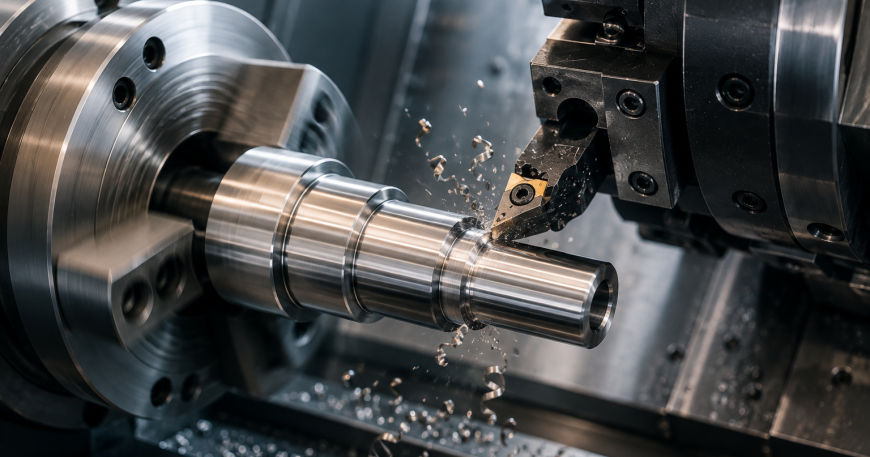
Modern manufacturing demands components with high dimensional accuracy, consistent quality, and reliable performance. CNC turning has become an important machining process for producing precision components efficiently while maintaining repeatability across production runs.
What Is CNC Turning?
CNC turning is a computer-controlled machining process in which a workpiece rotates while cutting tools remove material to create the required shape and dimensions.
The process is commonly suitable for manufacturing cylindrical and rotational components such as shafts, bushes, sleeves, pins, flanges, and other precision-engineered parts.
Advantages of CNC Turning
Modern CNC turning provides several advantages for industrial manufacturing:
- High dimensional accuracy
- Consistent and repeatable machining
- Better surface finish
- Efficient production of complex components
- Reduced manual intervention
- Improved production efficiency
- Capability to manufacture components with tight tolerances
Once machining parameters are correctly established, CNC equipment can repeatedly manufacture components according to specified dimensions.
Importance of Accuracy in CNC Components
Accuracy is critical in engineering applications. A small dimensional variation in a component can affect assembly, movement, alignment, and overall equipment performance.
Precision CNC turning helps maintain important parameters such as diameter, length, concentricity, threads, grooves, and surface finish according to component requirements.
CNC Turning for Different Industrial Requirements
Every manufacturing requirement can be different. Depending on component design and application, CNC turning can be used for prototypes, replacement components, customized engineering parts, and production requirements.
Proper machine selection, tooling, machining parameters, inspection, and operator experience all contribute to achieving dependable results.
Combining CNC Turning with Other Machining Capabilities
Complex engineering components may require more than one manufacturing process. CNC turning can work alongside capabilities such as:
CNC Machining | VMC / VTL Machining | Precision Grinding | Tooling & Fixtures | Special Purpose Machines | Automation & Robotic Tooling
Combining different machining processes can help achieve the required geometry, dimensional accuracy, and surface quality for demanding applications.
Quality Control in CNC Turning
Producing a component is only one part of precision manufacturing. Inspection and quality control are equally important.
Measurements should be verified against the required specifications during appropriate stages of manufacturing. This helps identify deviations early and supports consistent quality in finished components.
Supporting Modern Manufacturing
As industries continue to demand higher accuracy, faster production, and dependable component quality, CNC technology continues to play an important role in modern manufacturing.
At Mecprosys, the focus is on supporting industrial requirements through precision-oriented machining and engineering solutions.
Looking for CNC Turning & Precision Machining Solutions?
Whether the requirement involves a single specialized component or ongoing manufacturing support, choosing the right machining partner can contribute to better quality, consistency, and productivity.
Contact Mecprosys to discuss your CNC turning, precision machining, tooling, and engineering requirements.